
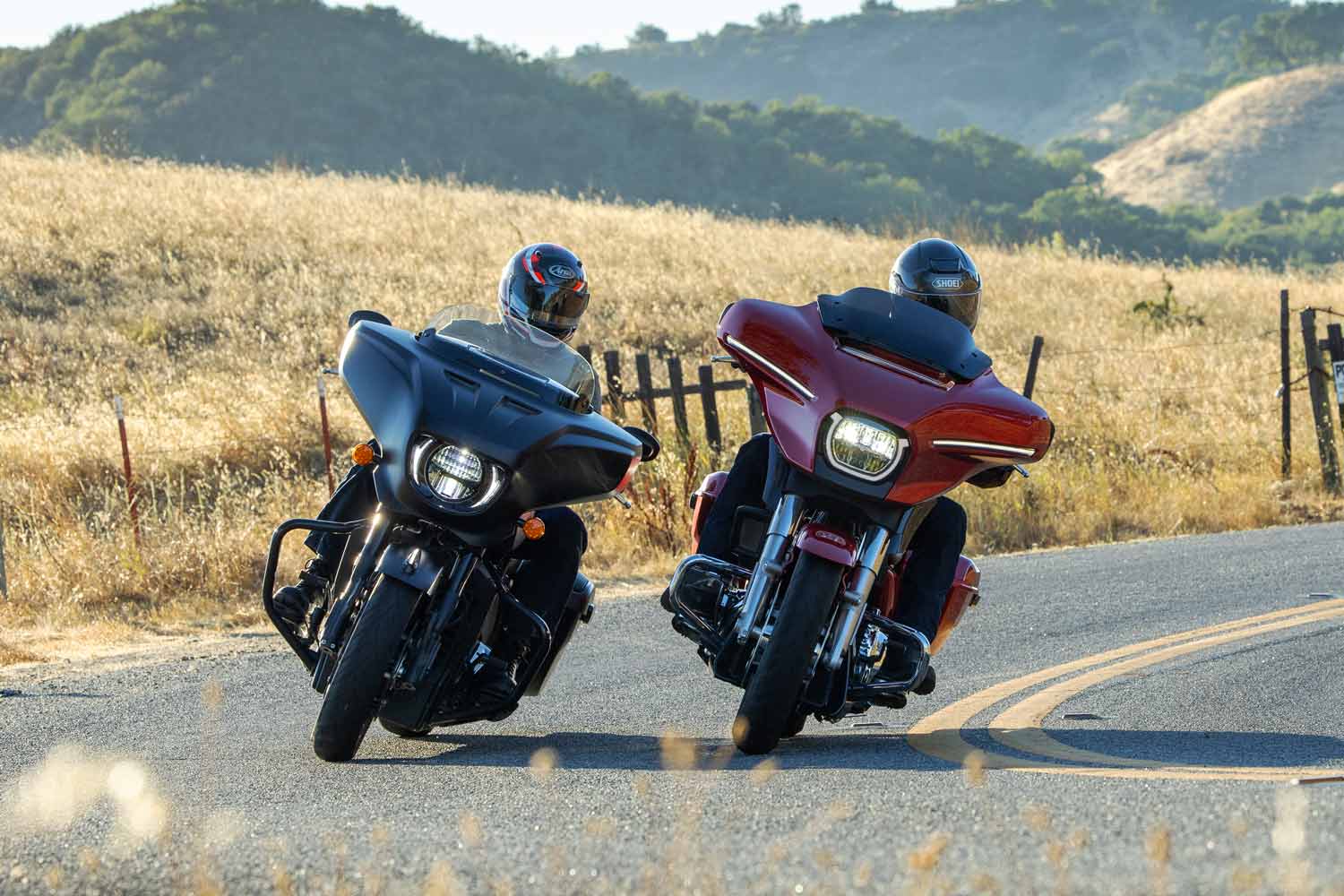
We love a good, old-fashioned rivalry. Army vs. Navy. Ford vs. Chevy. Coke vs. Pepsi. And of course, Harley-Davidson vs. Indian. Two of the oldest American motorcycle brands – Harley-Davidson was founded in 1903 and has operated continuously ever since; Indian was founded in 1901, went bankrupt in 1953, and was resurrected in fits and starts until Polaris Industries took over in 2011 – have been fierce rivals in terms of design and engineering, sales at dealerships, and racing in multiple disciplines.
King Of The Baggers
Since 2021, Harley and Indian have battled it out in what was once an unthinkable class of racing: King Of The Baggers. Harley-Davidson Road Glides and Indian Challengers weighing more than 620 lb and equipped with stock-looking fairings and saddlebags slice and dice at Daytona, Road America, Laguna Seca, and other racetracks nationwide. The racebikes may look like those you see on showroom floors, but they’re highly modified, achieving speeds up to 185 mph and lean angles up to 55 degrees (compared to 32 degrees for a stock bagger).
KOTB has been wildly popular, and the Harley/Indian rivalry over the past five seasons has been tit-for-tat. The championship winner has alternated every year, with Harley earning three titles (2021, 2023, and 2025) and Indian earning two (2022 and 2024). In classic “win on Sunday, sell on Monday” fashion, Harley and Indian invest heavily in KOTB because they hope to sell more motorcycles to people like us.
In 2023, we compared the Harley‐Davidson Road Glide and the Indian Challenger during a ride to Laguna Seca to watch the KOTB races. The Challenger won by decision due to its superior engine performance, ride quality, comfort, wind protection, and standard features.
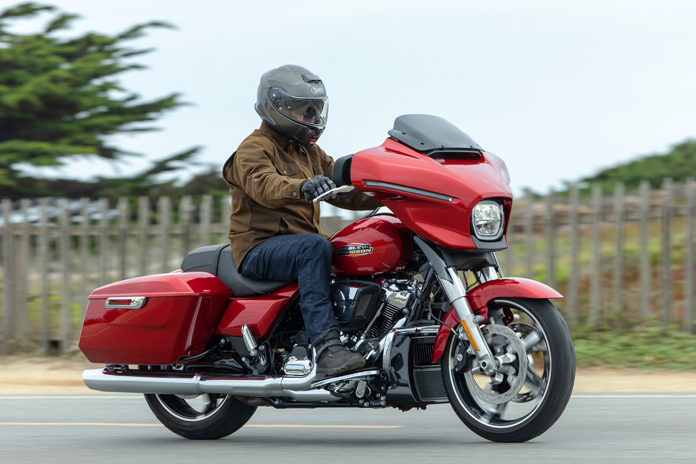
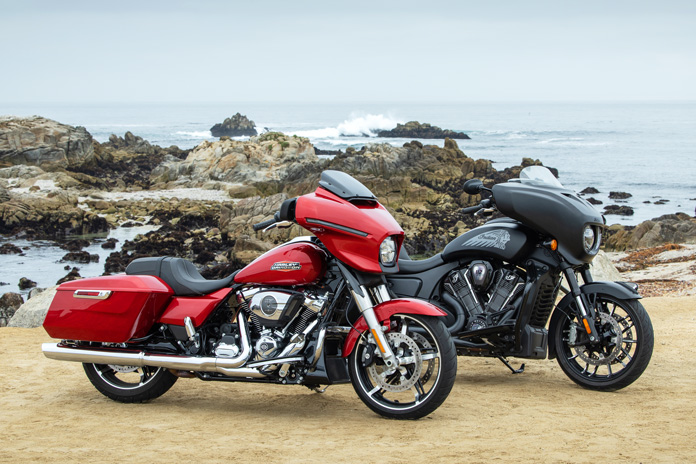
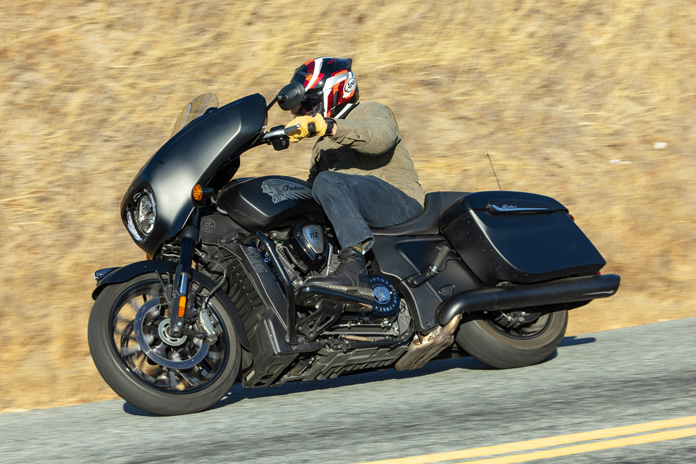
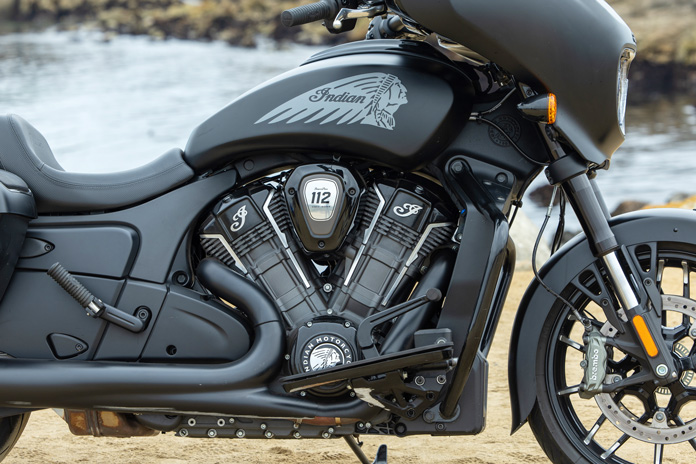
For KOTB racing, Harley and Indian run baggers with frame-mounted fairings, but in terms of retail sales, their baggers with handlebar-mounted fairings – Harley’s Street Glide and Indian’s Chieftain – are more popular. For 2025, Indian introduced the Chieftain PowerPlus, a model mashup that combines the Chieftain’s fairing and the Challenger’s liquid-cooled PowerPlus V-Twin. Also new this year, in addition to the 108ci (1,768cc) version of the PowerPlus, Indian offers a 112ci (1,835cc) version, the same displacement used in its KOTB racebikes (but certainly not tuned the same!).
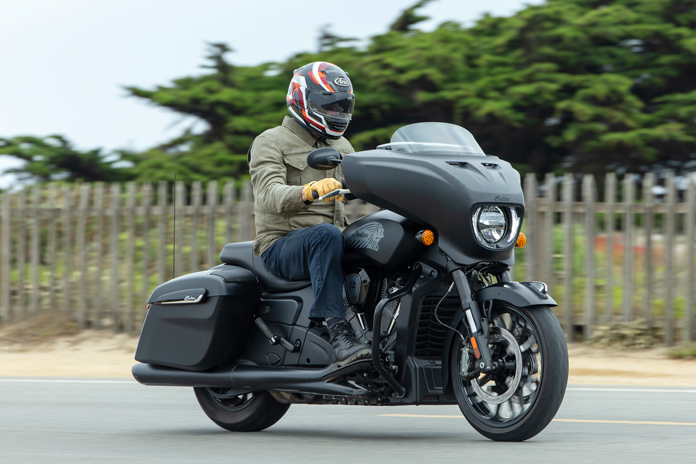
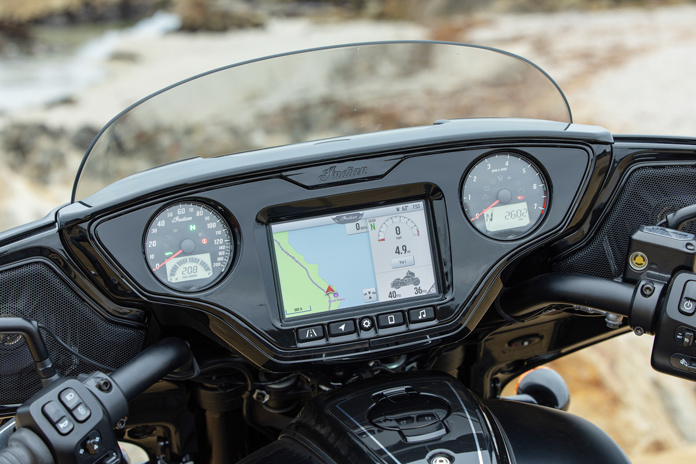
Standard equipment on Indian’s PowerPlus 112 models includes a 6-axis IMU with SmartLean Technology (lean-sensitive ABS and traction control), electronically linked brakes, hill-hold control, remote locking saddlebags, and the radar-enabled Rider Assist Package with blind-spot and tailgate warnings and rear-collision warning lights. Behind the fairing is a 7-inch touchscreen TFT display with Indian’s Ride Command infotainment system, which includes an audio system, Apple CarPlay, Bluetooth, navigation with traffic updates, tire-pressure monitoring, and customizable displays.
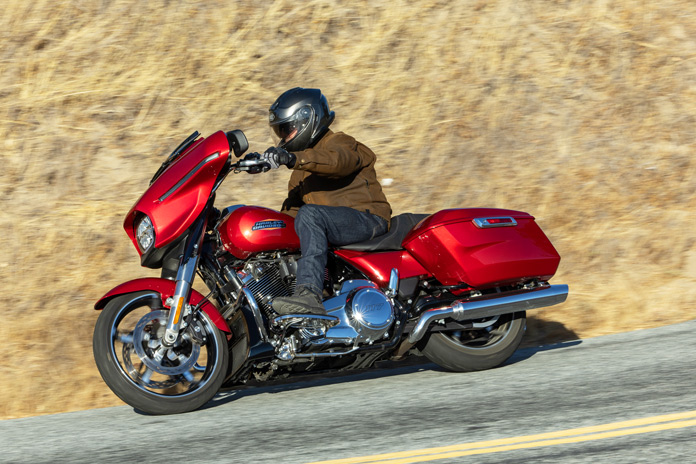
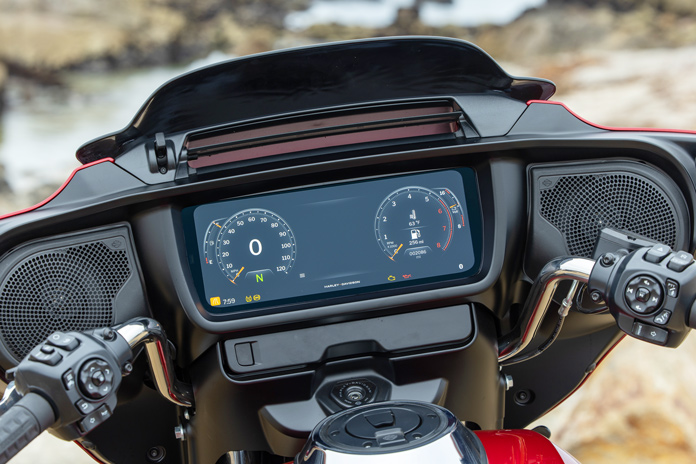
When the Harley-Davidson Street Glide was updated in 2024, it lost weight, gained power, added rear suspension travel, and got a fresh look, with more modern, sculpted lines on its batwing fairing and saddlebags. Similar to the Indian, the Harley’s standard Rider Safety Enhancements electronic package includes electronically linked brakes, cornering ABS, traction control, Drag Torque Slip Control, and hill-hold control. The Harley isn’t available with radar-enabled safety features, but its 12.3-inch touchscreen TFT display is massive and includes customizable displays and infotainment capabilities like those on the Indian.
Start Your Engines
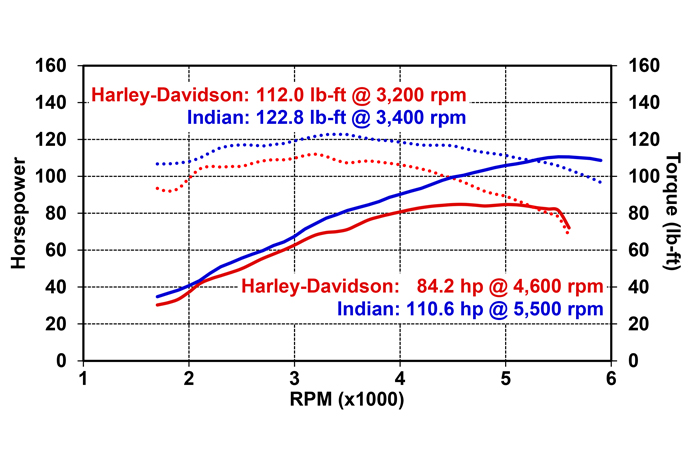
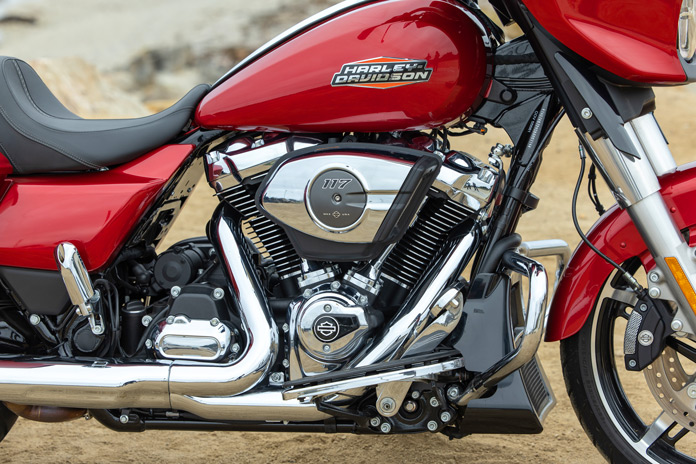
Although Harley’s Milwaukee-Eight 117 V-Twin has liquid-cooled cylinder heads and wins the displacement arms race – 1,923cc vs. 1,835cc for the PowerPlus 112 – Indian’s fully liquid-cooled, higher-compression powerplant was dominant on Jett Tuning’s rear-wheel dyno. As shown in the chart, the Indian outguns the Harley throughout the rev range, and its advantage increases with revs above 3,000 rpm. Peak figures for the Harley – 84.2 hp at 4,600 rpm and 112 lb-ft of torque at 3,200 rpm – are respectable, but the Indian blows them away: 110.6 hp at 5,500 rpm and 122.8 lb-ft at 3,400 rpm.
As with most modern motorcycles, these big baggers use throttle-by-wire to meter fuel and air, and selectable ride modes that adjust throttle response and other parameters are standard – Road, Sport, Rain, and Custom on the Harley; Standard, Sport, and Rain on the Indian. Both have 6-speed transmissions with slip/assist clutches and maintenance-free belt final drive.
These baggers truly are big. Fueled up and ready to ride, the Indian tips the scales at 842 lb while the Harley weighs 811 lb. That 31-lb weight difference amounts to less than 4% of the Harley’s mass, but it feels much lighter when lifting it off the sidestand and pushing it around. The Indian is not only heavier, it’s also longer, stretching 65.7 inches between the axles versus 64 inches on the Harley. And from nose to tail, the Indian is almost a half-foot longer: 98.5 inches vs. 92.9. From the saddle, the Harley feels more compact, with the handlebar, fairing, and footboards closer to the rider than on the Indian.
King of the Road
Spec sheets and dyno charts are one thing, but in a comparison test the rubber needs to meet the road. Longtime contributor and friend of the magazine Thad Wolff and I filled the top-loading saddlebags and headed north, with photographer Kevin Wing chasing us on a third bike. Both baggers have nearly 70 liters of storage capacity, and their fairings include storage compartments with USB ports for charging smartphones. We appreciated the convenience of the Indian’s remote-locking saddlebags; the Harley’s bags require a key to lock.
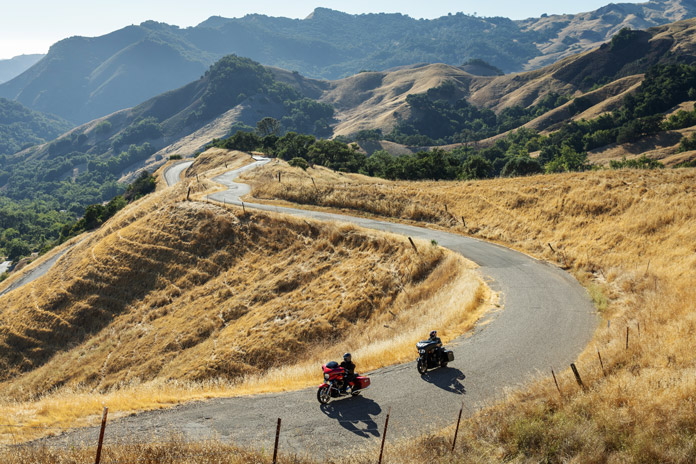
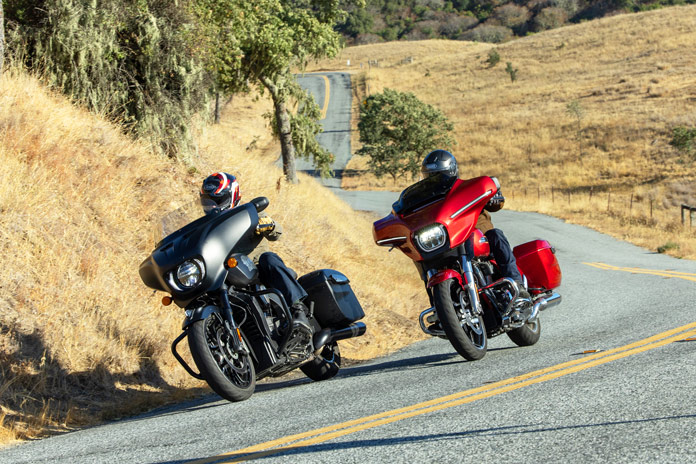
We plotted a route that was a greatest-hits list of Southern California backroads: SR-33 through Los Padres National Forest, SR-58 across the Carrizo Plain, the short but diabolical SR-229 (aka Rossi’s Driveway), and Carmel Valley Road, a rural two-lane that curves, dips, and climbs from the agricultural fields of the Salinas Valley to the Pacific Coast. We also threw in some freeway miles on U.S. Route 101 for good measure.
The Indian PowerPlus 112’s torque advantage, which ranges from 6 lb-ft at 2,100 rpm to more than 20 lb-ft above 4,800 rpm, is certainly felt from the saddle. Even though the Chieftain carries some extra weight, it launches off the line and accelerates with more gusto than the Street Glide. That’s what most riders love about big V-Twins, the ability to drop the hammer with a quick twist of the wrist regardless of gear, and the Indian delivers in spades. But once you hit the Chieftain’s torque peak around 3,400 rpm, engine vibration becomes more pronounced, which can feel coarse depending on throttle position. What the Harley lacks in absolute grunt it makes up for in smoothness. Not a dull or boring smoothness, but a finely tuned thrum.
We’ll admit, our pace was not what you’d call relaxed cruising. Thad is a mellow dude, but he’s also a former AMA Superbike racer, so even when he’s going slow he’s pretty darn fast. I’ve never been a racer, but my default mode is overcaffeinated and impatient, so I like to burn carbon off the cylinders whenever I can. Our fuel economy suffered, but our spirits soared.
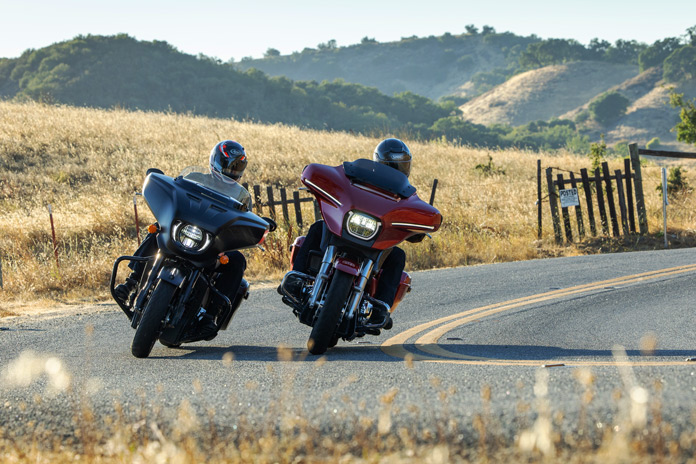
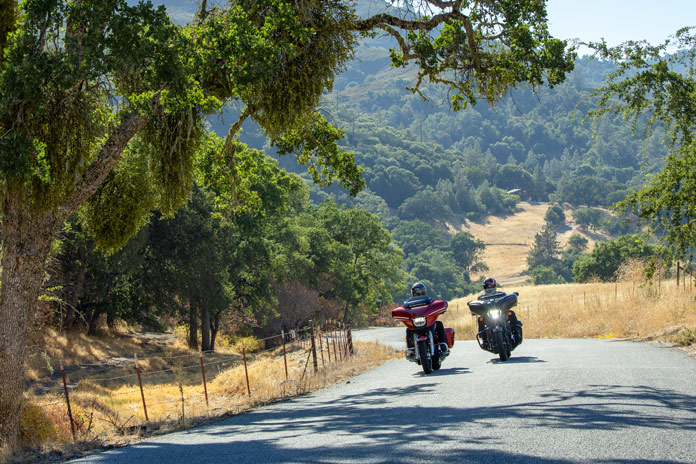
What surprised us was how well these big baggers did when pushed hard on technical backroads. Not for lack of trying, we rarely scraped their footboards. The weight of heavy fairings on their handlebars didn’t adversely affect handling, and their tires – Dunlop Harley-Davidson Series (D408/D407) on the Street Glide and Metzeler Cruistecs on the Chieftain – provided reassuring grip on pavement of varying quality. Comfort-wise, however, the Indian clearly outshines the Harley. The Chieftain’s single rear shock with 4.5 inches of suspension travel soaks up hard hits much better than the Street Glide’s dual shocks with 3 inches of travel. And although both baggers have wide, deeply dished seats, the Indian’s is more supportive.
The Harley’s lighter weight and shorter wheelbase give it an edge in terms of handling. The Harley-Davidson Street Glide dips into corners, carves around hairpins, and does tight U-turns more readily than the comparatively ponderous Chieftain. Both bikes are dead-nuts stable on straight roads regardless of speed (and both have standard cruise control), and it is during highway cruising when the Chieftain’s more spacious cockpit is appreciated. The rider can stretch out more, and the Indian’s longer footboards provide more options for leg position.
Both baggers have batwing-style fairings that protect the rider’s torso and arms from wind and weather, and both have ultra-bright LED headlights to illuminate the road after dark. There’s a big difference, however, in terms of windscreens. The Harley has a dark-tinted shorty screen that is mounted at a flat angle atop the fairing, and below it is a vent that reduces turbulence. Thad, who is 5-foot-8, could see over the dark screen but complained about not being able to see through it; at 6-foot, I was able to see well over it. The Indian has a lightly tinted windscreen that has a steeper angle and is electrically height adjustable. When raised up, it creates a quiet pocket of air in the cockpit.
Slowing these baggers down is the job of dual 4-piston front calipers pinching large 320mm discs plus a single rear caliper. Both offer serious stopping power, but the Harley has a more aggressive initial bite, and its rear 4-piston caliper can even feel grabby if the pedal is not applied with finesse. Cornering ABS is standard on both bikes and provides a reassuring margin of safety on dirty or slippery roads.
Coastal Cruising
We packed in about 350 miles on our first day, logging more than 10 hours of riding and photography with a midday break for tacos in Atascadero. We ended up in Monterey, home to Cannery Row and a world-famous aquarium. As we walked to a brewpub for dinner, we swapped stories about past rides and shoots, memorable moments and embarrassing ones, and how we were much more reliant on ibuprofen and a good night’s sleep than we used to be. Like my dad used to say, it sucks getting old, but it beats the alternative.
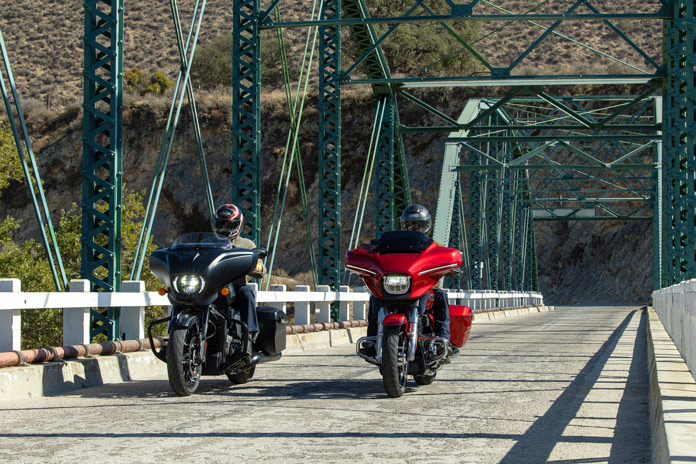
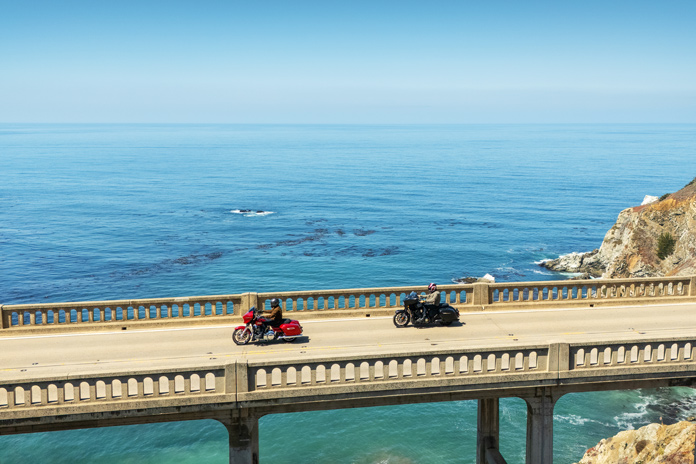
The next day, we cruised along the rocky shore of Pacific Grove and down State Route 1 to Bixby Bridge, which was built in 1932. Sitting on the rugged coast just north of Big Sur, it’s one of the most photographed bridges in California (it’s on the cover of this issue). SR-1 south of Big Sur was closed due to a landslide, so we backtracked to Carmel, swung around to the Salinas Valley, stopped for our daily ration of tacos in King City, and then rode south to Fort Hunter Liggett, an Army base that allows access to Nacimiento-Fergusson Road, a beat-to-hell, lane-and-a-half-wide road that climbs over the Santa Lucia Mountains to SR-1. Riding through a dark canopy of trees, we hit hidden potholes and gravity cavities that bottomed out the suspension, scraped hard parts, and compressed our spines. The road is steep and treacherous and has steep drop-offs with no guard rails, and we absolutely love it. More of an adventure-bike road, for sure, but you ride the bike you’re on and make the most of it.
When we stopped for gas or tacos or photos or more ibuprofen, Thad and I compared notes on the Harley and Indian. We were generally in agreement with Kevin Duke’s assessment of the Chieftain PowerPlus that “Indian has built one of the best baggers in America.” By most of the criteria used in a touring-bike comparison test – performance, comfort, ride quality, wind protection, technology, and convenience – the Indian beats the Harley. The Street Glide is lighter and more compact, which gives it sharper handling, but on the wide-open roads where big baggers spend most of their time, such an advantage becomes less important.
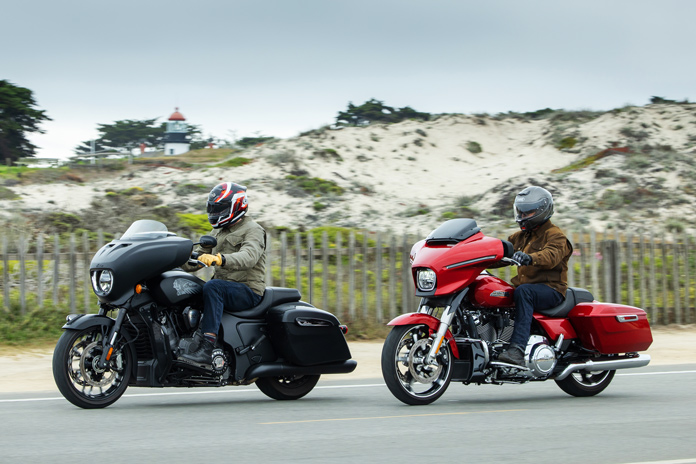
Just as the Indian Challenger did against the Harley Road Glide back in 2023, the Indian Chieftain PowerPlus wins by decision. However, there are less tangible qualities to consider. One is styling, which is in the eye of the beholder, but to us, the Street Glide looks more cohesive, more harmonious. Harley-Davidson has been making variations of this motorcycle since the batwing fairing debuted on the 1969 FLH Electra Glide, so it has had decades to get the formula right. That’s where the Milwaukee-Eight 117’s smoothness comes in too. Cruising down the road on a Street Glide just feels right.
It always seems like a cop out to say “you can’t go wrong with either bike” at the end of a comparison test, but in this case it’s true. Harley and Indian are fierce competitors, so it’s no surprise that they’ve built similar bikes in an effort to attract similar customers: those who want an American-made V-Twin bagger for the open road. Some will choose purely based on brand preference, some will buy based on specs or price, and others will buy purely on emotion. None of them will be wrong.
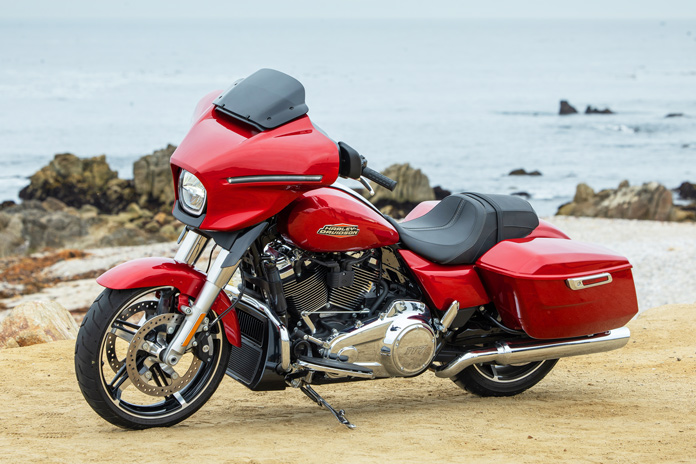
2025 Harley-Davidson Street Glide
- Base Price: $27,749
- Price as Tested: $28,599 (Brilliant Red)
- Warranty: 2 yrs., unltd. miles
- Website: Harley-Davidson.com
ENGINE
- Type: Air-/liquid-cooled, transverse 45-degree V-Twin, OHV w/ 4 valves per cyl.
- Displacement: 117ci / 1,923cc
- Bore x Stroke: 103.5 x 114.3mm
- Horsepower: 84.2 @ 4,600 rpm (rear-wheel dyno)
- Torque: 112.0 lb-ft @ 3,200 rpm (rear-wheel dyno)
- Compression Ratio: 10.3:1
- Valve Insp. Interval: NA (self-adjusting)
- Fuel Delivery: Electronic Sequential Port Fuel Injection
- Lubrication System: Dry sump, 5.0 qt. cap.
- Transmission: 6-speed, cable-actuated slip/assist wet clutch
- Final Drive: Belt
CHASSIS
- Frame: Tubular-steel double cradle w/ two-piece backbone & steel swingarm
- Wheelbase: 64 in.
- Rake/Trail: 26 degrees/6.7 in.
- Seat Height: 26.4 in. (laden)
- Suspension, Front: Conventional fork w/ 49mm stanchions, no adj., 4.6 in. travel
- Rear: Dual shocks, adj. preload, 3.0 in. travel
- Brakes, Front: Dual 300mm floating discs w/ 4-piston calipers, fully linked & ABS
- Rear: Single 300mm fixed disc w/ 4-piston caliper, fully linked & ABS
- Wheels, Front: Cast, 3.50 x 19 in.
- Rear: Cast, 5.00 x 18 in.
- Tires, Front: 130/60-B19
- Rear: 180/55-B18
- Wet Weight: 811 lb
- Load Capacity: 549 lb
- GVWR: 1,360 lb
- Fuel Capacity: 6 gal.
- Fuel Consumption: 41.7 mpg
- Estimated Range: 250 miles
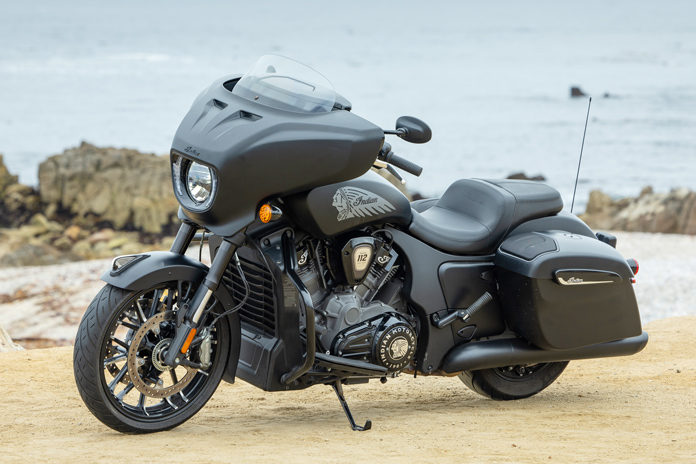
2025 Indian Chieftain PowerPlus
- Base Price: $26,499
- Price as Tested: $32,749 (Dark Horse w/ 112 & PowerBand Audio)
- Warranty: 2 yrs., unltd. miles
- Website: IndianMotorcycle.com
ENGINE
- Type: Liquid-cooled, transverse 60-degree V-Twin, SOHC w/ 4 valves per cyl.
- Displacement: 112ci / 1,835cc (as tested)
- Bore x Stroke: 110.0 x 96.5mm (as tested)
- Horsepower: 110.6 @ 5,500 rpm (rear-wheel dyno)
- Torque: 122.8 lb-ft @ 3,400 rpm (rear-wheel dyno)
- Compression Ratio: 11.4:1 (as tested)
- Valve Insp. Interval: NA (self-adjusting)
- Fuel Delivery: EFI, 52mm dual-bore throttle body x 2
- Lubrication System: Semi-wet sump, 5.0 qt. cap.
- Transmission: 6-speed, cable-actuated slip/assist wet clutch
- Final Drive: Belt
CHASSIS
- Frame: Modular cast-aluminum main frame w/ engine as stressed member & cast-aluminum swingarm
- Wheelbase: 65.7 in.
- Rake/Trail: 25 degrees/5.9 in.
- Seat Height: 26.5 in. (laden)
- Suspension, Front: Inverted fork, no adj., 5.1 in. travel
- Rear: Single shock, adj. preload w/ remote, 4.5 in. travel
- Brakes, Front: Dual 320mm semi-floating discs w/ 4-piston radial calipers, fully linked & ABS
- Rear: Single 298mm floating disc w/ 2-piston caliper, fully linked & ABS
- Wheels, Front: Cast, 3.50 x 19 in.
- Rear: Cast, 5.00 x 16 in.
- Tires, Front: 130/60-B19
- Rear: 180/60-R16
- Wet Weight: 842 lb (as tested)
- Load Capacity: 543 lb (as tested)
- GVWR: 1,385 lb
- Fuel Capacity: 6 gal.
- Fuel Consumption: 40.2 mpg
- Estimated Range: 240 miles